Is Business English Worth It in Portugal? The Real Value for Professionals
Sometimes English is not the goal.
Sometimes it is the gatekeeper standing between you and what you actually want: an international position, a promotion, a degree, a new country or the career you have worked years to build.
Now that I am based in Lisbon, I see this from a new perspective.
Portugal attracts professionals, entrepreneurs and international companies from many different countries. A meeting in Lisbon may include colleagues from Portugal, Spain, France, Germany, Brazil, the United Kingdom or the United States. English becomes the shared language—but speaking it confidently in that environment requires more than knowing grammar.
It requires the ability to explain your thinking, participate in meetings, ask good questions and contribute when your experience matters.
That is the real value of Business English.
English can open the door, but you still have to walk through it
Years ago, I worked with a doctor preparing for one of the most competitive medical specialization programs in Colombia.
Candidates had to pass two major exams: one on medicine and another on English. He passed the medical examination but failed the English test. We worked together, and on his next attempt, he passed the English requirement—but failed the medical portion.
He eventually continued his journey in Mexico, where he found another opportunity to specialize.
Life does not always follow the timeline we planned. Sometimes we prepare, work and overcome one obstacle only to encounter another.
What matters is what we do next.
In baseball, when a pitch hits you, you do not abandon the game. You take your base, breathe and keep playing.
That doctor kept playing.
The professionals who eventually reach their goals are often the ones who refuse to let one difficult moment define their entire career.
English doesn’t create talent. It amplifies it.
One of my favorite success stories is a former student named Camilo.
When we started working together, he was an investment analyst. He was intelligent, disciplined and already had a strong academic background. His English was around a pre-intermediate level, and over time, he developed it to an advanced level.
English helped him access opportunities that would otherwise have been difficult to pursue. He earned a Fulbright scholarship, completed a master’s degree at New York University, joined a US company and later helped that company expand into Colombia.
That expansion created jobs and opportunities for other people.
English did not make Camilo talented.
He was already talented.
English amplified his talent and gave it a larger stage.
The same principle applies to professionals in Portugal. English does not replace technical expertise, experience or leadership. It allows those qualities to travel beyond one language, one market or one country.
Why Business English matters in Portugal
Portugal is both a local market and a gateway to international work.
Professionals in Lisbon, Porto and other business centres increasingly interact with international clients, remote teams, regional offices and colleagues across Europe. Portuguese companies expand internationally, while multinational organizations build teams in Portugal.
In these environments, English is not simply another skill on a résumé. It is often the language through which work happens.
You may need English to:
* Participate in meetings with international colleagues
* Present a project to regional leadership
* Explain a technical problem to a client
* Negotiate priorities, deadlines or resources
* Interview for a position with a global company
* Build professional relationships across cultures
* Access international research, training and technology
The challenge is that understanding English and operating professionally in English are not the same thing.
Many capable professionals follow the conversation but hesitate when it is time to contribute. They know the answer, but they cannot express it with the same confidence or precision they have in Portuguese or Spanish.
That gap can make talented people appear less experienced than they really are.
Business English coaching helps close it.
Can English help you get promoted?
The honest answer is yes and no.
As you move up inside an organization, the structure begins to resemble a pyramid. There are fewer positions at the top and more qualified people competing for them.
English is rarely the main reason someone receives a promotion.
Performance comes first. Results come first. Leadership comes first.
However, when two candidates have similar qualifications, English can become the final filter.
One person may be ready to manage an international team, present to regional leadership or work directly with an overseas client. The other may have similar technical abilities but cannot yet communicate them confidently in English.
Sometimes English is not the promotion.
It is the tie-breaker.
Can Business English increase your earning potential?
There is no universal percentage or guaranteed salary increase.
The financial value of English comes from access.
It can make it possible to pursue international clients, global teams, leadership positions, consulting projects, professional certifications, graduate programs and overseas assignments.
In technology, finance, consulting and other internationally connected industries, I have seen positions pay considerably more because they required communication with global teams.
For professionals living in Portugal, English may also provide access to remote opportunities beyond the Portuguese market.
The greatest financial benefit is not always a direct salary increase. It is the number and variety of opportunities that become visible once language is no longer the barrier.
English helps you see what everyone sees—and notice what others may miss.
Business English is not simply advanced English
One of the biggest misconceptions is that Business English is just a more difficult version of general English.
It is not necessarily harder. It is more relevant.
Instead of spending every lesson talking about holidays, restaurants or imaginary textbook situations, professionals can discuss:
* Leadership
* Project management
* Customer experience
* Negotiations
* Artificial intelligence
* Finance
* Productivity
* Strategy
* Cross-cultural communication
* Real situations from their working lives
When people discuss topics that matter to them, they become more engaged. They ask better questions, share experiences and remember more of the language.
They stop learning English only as a subject and begin using it as a professional tool.
What is the fastest way to improve Business English speaking?
After more than two decades of working with professionals, I recommend three things.
1. Prepare before the session
The best classes begin before the lesson starts.
Review the topic, learn useful vocabulary and think about how the subject connects to your own experience. When you arrive prepared, the session becomes a discussion rather than a lecture.
You are no longer waiting for the teacher to give you something to say.
You already have something to contribute.
2. Speak more and worry less
Many professionals spend too much time trying to construct a perfect sentence before speaking.
By the time they are ready, the conversation has moved on.
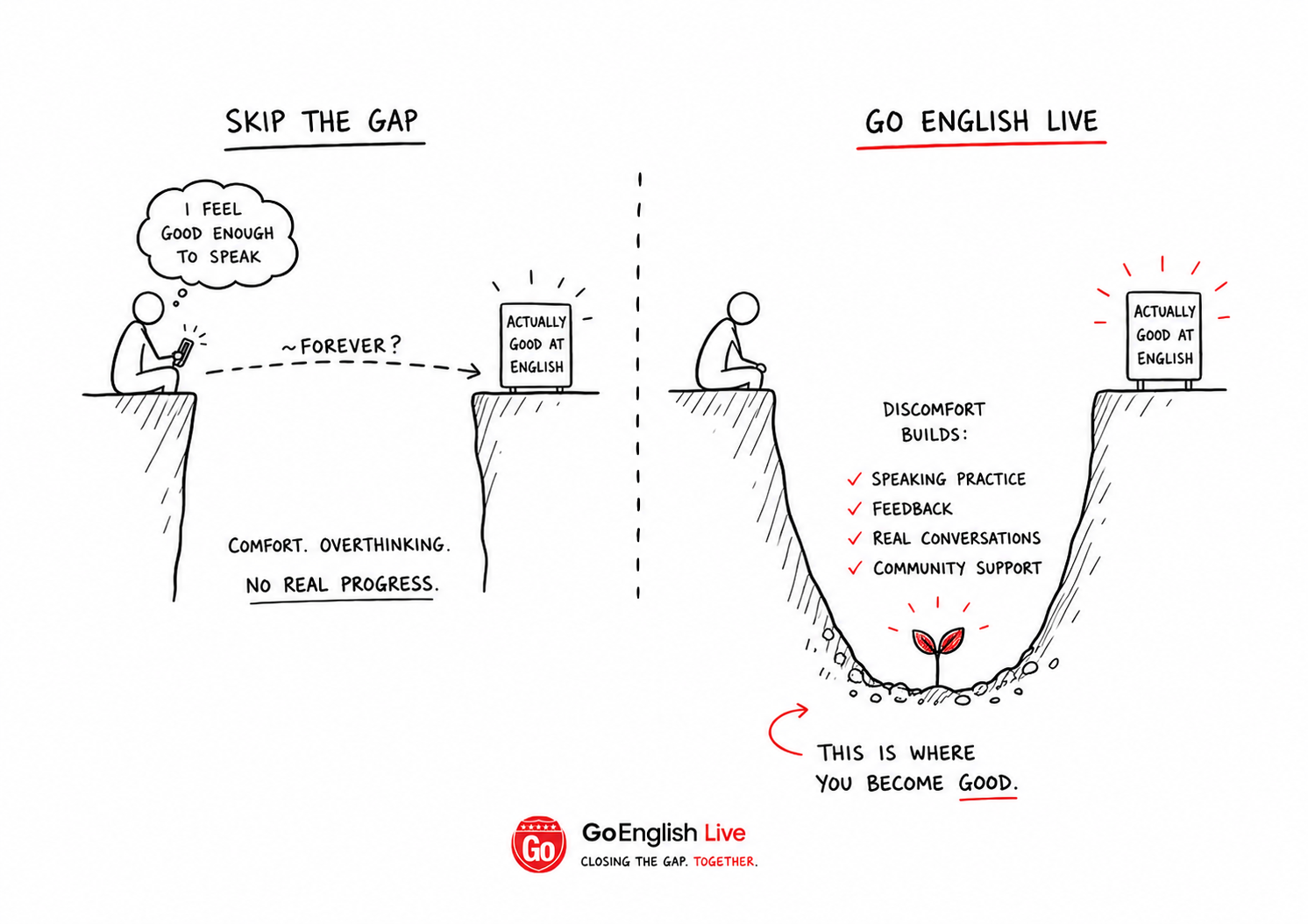
Clarity matters, but perfection is not the goal. Speak, test the language, receive feedback and try again. Confidence develops through participation.
3. Activate English outside the classroom
My preferred formula is:
* One hour of live coaching
* One hour of preparation
* Six hours of activation
Activation does not mean traditional homework. It means bringing English into your normal professional and personal life through podcasts, books, meetings, articles, videos, presentations and conversations.
This sustained exposure is where long-term progress happens.
Consistency matters more than intensity.
Do you need to lose your accent?
No.
Pronunciation matters. Clarity matters. Communication matters.
A perfect British or American accent does not.
Lisbon is an international city. In one meeting, you may hear Portuguese, Brazilian, Spanish, French, German, Indian or Colombian accents. Effective international communication is not about everyone sounding the same.
It is about understanding and being understood.
You can speak fluently and still have an accent. You can lead an international team and have an accent. You can build trust, present ideas and negotiate successfully without imitating a native speaker.
Your goal should be clear, confident communication—not linguistic disguise.
The benefits extend beyond speaking
Many professionals focus on conversation, but some of the greatest benefits of English happen elsewhere.
English can give you earlier or broader access to:
* Books and research
* Industry publications
* International conferences
* Professional certifications
* Global networks
* Emerging technologies
* Artificial intelligence tools
* International employment opportunities
One former student, a Vice President of Investments, told me that improving his English would help him read more.
That is exactly what happened.
His English improved. His reading expanded. His learning accelerated.
For many professionals, the greatest return on their investment in English is not speaking.
It is learning.
Stop chasing levels and start building capability
Qualifications such as A1, B2 and C1 provide a useful reference point. They can also be required by universities, employers and immigration processes.
But a level does not tell the complete story.
A professional may hold a B2 certificate and still remain silent during an important meeting. Another person may make grammatical mistakes but communicate ideas clearly, ask intelligent questions and build trust with international colleagues.
Language is not something you finish.
If you do not use it, you gradually lose it. Successful learners treat English in the same way athletes treat physical fitness. They do not exercise to “complete” fitness. They train to remain capable.
Your level matters, but what you can do with the language matters more.
Learn through English, not only about English
This is the idea at the centre of our work at Go English Live.
Our coaching uses business topics as the starting point. We discuss leadership, motivation, customer experience, productivity, projects and decision-making. We then connect those ideas to the situations our students face at work.
The goal is not to transfer content from a textbook.
The goal is to help professionals grow while developing the English needed to communicate that growth.
The students who progress the most are often the ones who stop treating English as the subject and begin using it as the vehicle.
The real goal
When I think about what I want for our students in Portugal and across the international markets we serve, the goal is not simply fluency.
I want them to become lifelong learners.
At Go English Live, our coaches come from different countries, cultures and professional backgrounds. We look for people who are curious and constantly learning themselves because good coaches remain learners first.
When students work with coaches who read, question, experiment and continue developing, learning becomes contagious.
The transformation is not just better English.
It is greater confidence in international environments, more access to knowledge and a larger professional world.
English does not create your talent.
It allows more people to see it.
And no matter what knocks you down along the way, you get back up.
— Mauricio Lopez
CEO & Founder, Go English Live